Behold : A Four Part pan - African Design Series
- Lethabo Xulu

- Apr 30, 2024
- 3 min read
Updated: May 3, 2024
Part 1 - Foundations
In this 4 part African design series I'd love you journey with me as we will explore the effects of visual stimulation and representation of African design hertitage and how this has shaped, shapes and will continue to shape us...and the world over. The visual notes in our surroundings around us today are a product of what we have come to behold or lack thereof.
In imagining pre-colonial Africa and particularly South Africa, we confront a important question: If colonisation hadn't occurred, would we have drawn from our design heritage to shape our built environment? Yes, the answer is yes. This introspection prompts us to consider how our ancestors' design choices—materiality, form, and construction—were ingrained with specific beliefs and cultural elements. These considerations laid the foundation for a rich, indigenous aesthetic that resonated with the essence of our communities. My previous article unpacks the need for a new design lexicon highlighting how we speak about our historical artefacts, practices and even materiality impacts our current perception of ourselves and all of life around us. The same can be said about the need to change what we see, daily.
The essence of "we become what we behold" resonates deeply with me. Lets's take graduates who often mirror the paths of those before them in their families or communities. These visual and felt cultural cues played a key role in shaping the path to wearing that graduation cap and gown. Now, what happens when the visual cues of our cultural heritage fade? What will become of the path that leads to design decisions made to establish the lived and built environment? The current state of African design reveals a crucial dilemma: firstly, the lack of recognition of traditional artefacts as design, leading to their replacement with objects considered to be acceptable as useful design. This shift deprives us of exploring our indigenous potential.
..and by potential, I'm not referring to the 10% of us design fundi's, I'm referring to the 90% who live, day by day, making, creating, mending, breathing and [not] seeing themselves in their surroundings and by 'selves' I mean the selves that existed pre-colonisation.
Decolonizing design thinking is imperative, yet it often seems inaccessible to the majority. I'm immersed in an industry where the majority resides—the 'informal' backroom housing sector, a thriving yet overlooked economic powerhouse. Niche companies like @indlu_living, bitprop and uMaStandi are helping reshape township real estate landscapes with safer, dignified structures, prompting me to think about the visual inspirations behind these structures. How can architects and spacial practitioners infuse cultural identities into these environments?
Inspired, and with a pan-African approach, I had fun in turning to AI to envision a backroom rentals infused with the aesthetic of the Senufo stool— a stool designed by the Senufo people who span across from West Africa, that's said to be 'the seat of the nations soul'. The process was enlightening, revealing the power of cultural narratives in shaping our surroundings.
Prompting AI was a hilarious exercise for me, as one who thinks about the future often, it's taken me a rather long to dabble in AI. Swipe through to see my amateur attempt at using Adobe Firefly. My prompts and rendering are followed by my thoughts on how visual cues could be interpreted by the diverse members of our society.

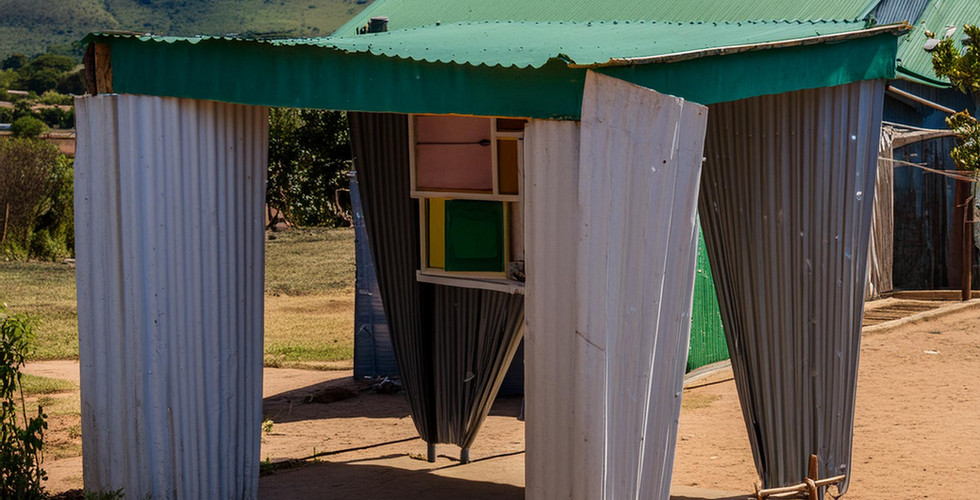


First Attempt: Prompt - "tiny house in South African township" As I mentioned, this was a fun exercise and funny looking, too. Needlesstosay, this is uninhabitable, swipe to the next one!
Second attempt: Prompt - "Modern tiny house, expanded living area, in South African township, urban mud finishes". Reflecting on this variation, the lower-income demographic of our population came to mind, that even with limited resources to build shelter, the aesthetic could have resembled inspiration drawn from traditional artefacts.
The third attempt was looking better, here is what I prompted: "Modern tiny house, expanded living area, in a South African city, mud-house finishes" . The living area's give us a glimpse of what the broader and more inhabitable space could look like but I must note that although this looks too small, it does reflect a lived reality for a sub-demographic of South Africans. The modern take in this rendering would be one that could be found nestled neatly within the tiny house movement, catering to the middle class and more conscious consumers.
Embracing our cultural heritage in design fosters a profound connection to our built environment, propelling us toward a more authentic and enriched aesthetic but we may not be able to get there if we can't behold said artefacts, their stories and their meaning. The distance seems great and like the graduate, if we don't behold, it may hinder us from becoming.


Comments